
With certain quarters demanding privatisation of public sector banks in the aftermath of the alleged fraud at Punjab National Bank (PNB), Economic Advisory Council to the Prime Minister chairman Bibek Debroy tells Sanjeeb Mukherjee, Ishan Bakshi and Indivjal Dhasmana that reducing government equity even to zero would not mean giving up of government control over these banks.

With the world's worst outbreak of COVID pandemic stalling a nascent economic recovery, the government has begun assessing the impact of the second wave of infections on different sectors and may look at providing support at an appropriate time to segments requiring fiscal help. Some of the economic indicators, including the Goods and Services Tax (GST) collections, still provide confidence and incoming data will throw some more light on the state of the economy, sources said. Services sectors like hospitality, tourism and aviation which had just started recovering were hit hard by the second wave of COVID, the sources said, adding these segments might need some support on an urgent basis from the government.

A political party's manifesto is the first stage of building a compact with the voters in any governance plan. If that compact is dependent on a document that reeks of fiscal imprudence and lacks credibility, it is a serious setback to the country's democracy and governance, says A K Bhattacharya.
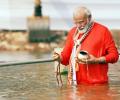
Syed Firdaus Ashraf/Rediff.com tracks Prime Minister Narendra Damodardas Modi's project-launching spree with just about three months to go for the assembly election in India's most populous state.

The government clarified that the majority of industrial establishments had reported nil production, and cautioned that the numbers should not be compared with those of previous months. "It is not appropriate to compare the IIP of April 2020 with that of earlier months, and users may like to observe the changes in the IIP in the following months," said the ministry of statistics & programme implementation.

Fintech players are customising solutions for rural markets and helping SMEs learn how to use the services

Top gainers in the Sensex pack include Yes Bank, TCS, Infosys, IndusInd Bank, HCL Tech, Bharti Airtel, HDFC, Sun Pharma, Bajaj Auto, ICICI Bank, Vedanta, Hero MotoCorp, ITC, Bajaj Finance, M&M and Tata Steel, surging up to 3.24 per cent.

Telecom companies have been desperately waiting for a bailout package from the government after a Supreme Court order put their statutory liabilities at Rs 1.47 lakh crore.

Experts said a dip in consumption expenditure indicated an increasing prevalence of poverty in the country.
The temporary disruptions (primarily to private consumption) caused by cash shortages accompanying the currency exchange initiative are expected to gradually dissipate in 2017 as cash shortages ease, the International Monetary Fund said in its regional economic outlook.
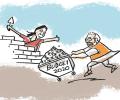
Apart from making your purchases on these platforms expensive, it will also mean sellers will have to face the brunt of reduced cash flows amid already low margins for some. Experts said the proposal, which will take effect on April 1, 2020, and will be inserted as a new section in the Income Tax Act, is expected to affect the working capital of e-commerce companies and reduce cash flows for e-sellers.
'It will take a long time for people's memory to be misled by a prime minister who is so arrogant and who refuses to acknowledge his own faults.'
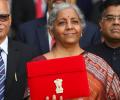
Had Finance Minister Sitharaman thought a little more about the middle class, disadvantaged sections, and the poor who are struggling, it would have been an inclusive Budget that would have made history, notes Ramesh Menon.

Investors must be prepared to believe that things will get better eventually, no matter how bad the current situation may look. If you don't possess this optimism, you will not possess the courage to invest and if you don't invest, you don't give yourself any chance to get wealthy, says Devangshu Datta.

Gujarat has around 3,000 licensees for allopathic drug manufacturing, apart from around seven homeopathic licensees, 500 ayuvedic and 600-700 cosmetics licensees

In the longest losing streak of 2017, the BSE Sensex has lost 1,270 points, or 3.91 per cent. It fell to a three-month low of 31,154.03 on Wednesday.
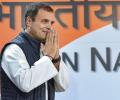
The Congress surveys, at least until now, have indicated the nationalistic fervour over the Pulwama terror attack is more an effort by mainstream media outlets, like news channels and newspapers, to shape a particular narrative, when the people on the ground are still asking basic questions of livelihood, jobs and better price for farm produce.
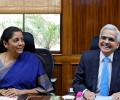
'We are very watchful about inflation and growth. But the main challenge is economic revival and growth.'

No government can 'ignore inclusiveness in a democracy', Montek Singh Ahluwalia tells Anjuli Bhargava.

Relax fiscal consolidation, boost public capex and reduce cost of finance, industry tells Centre

'For the first month, we have only had 5.5 million who have paid the tax.' '40 per cent have paid nil as tax; 95 per cent of the taxation for the first two months has come from only 400,000 assessees.' 'So even now, the tax-paying habit, of paying a marginal or negligible amount, or not paying anything at all, is quite prevalent,' reveals Finance Minister Arun Jaitley.
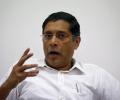
Chief Economic Advisor Arvind Subramanian says that he hopes GDP growth will be at the upper end of the 7-7.5 per cent range.

Loans, cash credits, and overdrafts at the end of December 22, 2017, stood at Rs 81,287.32 billion, against Rs 73,340 billion in the year-ago period.
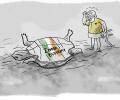
Even in this darkest hour of a crumbling economy and raging disease, there is hardly a murmur of protest against the government, observes Sumit Bhattacharya.

RailTel Corporation of India, Indigo Paints, Home First Finance Company, Indian Railway Finance Corporation, and Suryoday Small Finance Bank are among the companies looking to tap the market.

Sinha said the data on economic growth put out by the Central government cannot be trusted.

'After household expenses, we are left with nothing...' 'Sometimes I think it is better to shut the store...'

Even with the possible expenditure roll-overs and off-budget financing, the fiscal deficit target will not be met. The FRBM Act, after its amendment in 2018, allows a fiscal deficit slippage of not more than 0.5 per cent for any given year, provided there are justifications. These justifications include war, national security, severe collapse in the agriculture sector, a major natural calamity, big structural economic reforms, or the decline in real output growth of a quarter by at least 3 percentage points below its average of the previous four quarters.
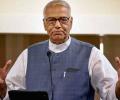
Yashwant Sinha explains where the Modi government has gone wrong in its handling of the economy.
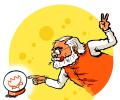
With GST, demonetisaton and the banking sector reset, investment banker Christopher Wood expects PM to focus on generating jobs ahead of the 2019 election.

After helping the government in policymaking since October 2014, Chief Economic Adviser Arvind Subramanian is returning to academics and will be teaching at Harvard Kennedy School on a visiting position. In an interview to Dilasha Seth and Somesh Jha, he says the ease of doing business agenda needs to move forward and India must try to integrate with the global value chains. Edited excerpts.

From Hyundai to Tata Motors, automakers are staring at a bleak future. With no succor provided in the Budget, the pain for companies is likely to continue for the next two quarters.

The standard line that is used for anyone -- academics, minorities, farmers, dissident industrialists -- who points out that what the government is doing is wrong is being anti-national and separatists, reveals Aakar Patel.

The department of economic affairs, in its Monthly Economic Review for September, said critical reforms undertaken by the government will put India to a strong and sustainable growth path in the long run.
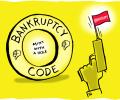
Experts consider Sebi's takeover code in its present form to be on a par with any foreign code governing public mergers and acquisitions.

'I hope the trend is sustainable and that economic activity accelerates going forward.'

The ongoing corporate results and the Union budget are also making participants tread cautiously though the GST agreement provided some relief.

Recent data from market analytics firm Nielsen shows that the rural market in the country's 630,000-odd villages is pulling down the overall FMCG business.

The previous high in quarterly GDP growth was recorded in the January-March quarter of 2015-16 at 9.3 per cent.

The size of the GDP in the second quarter of 2018-19 is estimated at Rs 33.98 lakh crore, as against Rs 31.72 lakh crore a year ago
